A Long Walk To Water Pdf Download
| Long Walk of the Navajo | |
|---|---|
| Office of the Navajo Wars | |
 Navajo people photographed during the Long Walk | |
| Location | Southwestern United States |
| Attack blazon | Forced displacement |
| Deaths | At least 200 |
| Victims | Navajo people |
| Perpetrators | U.Southward. Federal Government, U.S. Regular army |
| Motive | Acquisition of Navajo lands and forced cultural assimilation of Navajo people |
The Long Walk of the Navajo, also called the Long Walk to Bosque Redondo (Navajo: Hwéeldi), was the 1864 deportation and attempted ethnic cleansing[1] [ii] of the Navajo people past the United states of america federal authorities. Navajos were forced to walk from their state in what is now Arizona to eastern New Mexico. Some 53 unlike forced marches occurred between August 1864 and the terminate of 1866. Some anthropologists claim that the "collective trauma of the Long Walk...is critical to contemporary Navajos' sense of identity as a people".[three] [4]
Introduction [edit]

The traditional Navajo homeland spans from Arizona through western New Mexico, where the Navajo had houses, planted crops and raised livestock. There was a long historical design in the Southwest of groups or bands raiding and trading with each other, with treaties being fabricated and broken. This included interactions between Navajo, Spanish, Mexican, Pueblos, Apache, Comanche, Ute, and later European Americans. Individual civilians and Native Americans could be victims of these conflicts and as well instigate conflicts to serve their special interests.[5]
Hostilities escalated betwixt European Americans and Navajos post-obit the scalping of the respected Navajo leader Narbona in 1849.[half-dozen] In Baronial 1851, Colonel Edwin Vose Sumner established Fort Defiance for the U.S. authorities (most present-day Window Stone, Arizona) and Fort Wingate (originally Fort Fauntleroy near Gallup, New Mexico). Prior to the Long Walk, there were a series of treaties signed in 1849, 1858, and 1861.[note 1]
[edit]
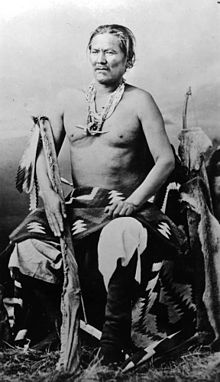
Manuelito, studio portrait, c. 1897

There are many examples of friction between invading European Americans and Navajo groups between 1846 and 1863. Manuelito (Hastiin Chʼil Haajiní) and Barboncito (Hastiin Dághaaʼ) reminded the Navajo that the Army was bringing in troops to wage war, it had flogged a Navajo messenger, and opened burn on tribal headsman Agua Chiquito, during talks for peace.[ citation needed ] They argued that the army had refused to bring in feed for their many animals at Ft. Disobedience, took over the prime grazing country, and killed Manuelito's livestock that was at that place. On Apr xxx, 1860, Manuelito and Barboncito with one,000 Navajo warriors attacked the fort and about took control.[7]
Typical truces and treaties said the army would protect the Navajo. Nonetheless, the army allowed other Native American tribes and Mexicans to steal livestock and capture Navajo to be used every bit slaves. A truce between the regular army and Navajo was signed on Feb 15, 1861.[viii] They were over again promised protection, just as part of the truce, two of the Navajo's four sacred mountains were taken from them, as well as well-nigh i-third of their traditionally held land. In March, a company of 52 citizens led by Jose Manuel Sanchez drove off a agglomeration of Navajo horses, but Helm Wingate followed the trail and recovered the horses for the Navajo, who had killed Sanchez. Another group of settlers ravaged Navajo rancherias in the vicinity of Beautiful Mountain. Likewise during this time, a political party of Mexicans and Pueblo Indians captured 12 Navajo in a raid, and three were brought in.[9]
On August 9, 1861, Lt. Col. Manuel Antonio Chaves of the New Mexico Volunteer Militia took command of a garrison of three companies numbering viii officers and 206 men at Fort Fauntleroy. Chaves was afterward accused of holding back supplies intended for the 1,000 or more Navajos that had remained close to the fort and was maintaining remarkably lax discipline. Horse races began on September 10 and continued into the late afternoon of September thirteen. Col. Chaves permitted Mail Sutler A. W. Kavanaugh to supply liquor freely to the Navajos. There was a dispute virtually which equus caballus won a race. A shot rang out, followed past a fusillade. Most immediately 200 Navajo, well-armed and mounted, advanced towards the Baby-sit, shooting at the men. They were fired upon by the soldiers and scattered, leaving 12 dead bodies and forty prisoners. On hearing this, Gen. Canby demanded a full report from Chaves, who did not comply. Col. Canby sent Captain Andrew W. Evans to the fort, named Fort Lyon since September 25, and he took control. Manuel Chaves, suspended from command, was confined to the limits of Albuquerque awaiting court-martial. (The charges were dismissed later on two months.) In February 1861, Manuel Chaves took the field with 400 militia and ransacked Navajo state, basically without federal dominance.[10]
Civil War and Kit Carson [edit]

Undated photo of Carson from the Library of Congress
With Confederate troops moving into southern New Mexico, Col. Canby sent Agent John Ward into Navajo lands to persuade any who might be friendly to move to a central encampment nigh the hamlet of Cubero where they would be offered the protection of the government. Ward was also instructed to warn all Navajos who refused to come in that they would be treated equally enemies; he was partly successful. Captain Evans was overseeing the abandonment of Fort Lyon and had been told that the new policy would be that the Navajo had to exist removed to settlements or pueblos, mentioning the region of the Petty Colorado westward of Zuni as peradventure an ideal place. In Nov, some Navajo were raiding again. On Dec 1, Col. Canby wrote to his superior in St. Louis that "recent occurrences in the Navajo country have and so demoralized and cleaved upwardly [the Navajo] nation that at that place is now no pick betwixt their accented extermination or their removal and colonization at points then remote...as to isolate them entirely from the inhabitants of the Territory. Aside from all considerations of humanity the extermination of such a people volition exist the work of the greatest difficulty".[xi]
Past 1862, the Union Ground forces had pushed the Confederates downwards the Rio Grande. The United States government over again turned its attention to the Navajos, adamant to eliminate Navajo raiding and raids on the Navajo. James H. Carleton was ordered to save Canby as the Commander for the New United mexican states Military Section in September 1862. Carleton gave the orders to Colonel Christopher "Kit" Carson to proceed to Navajo territory and to receive the Navajo surrender on July 20, 1863. When no Navajos showed up, Carson and another officeholder entered Navajo territory in an attempt to persuade Navajos to surrender and used a scorched earth policy to starve the Navajo out of their traditional homeland and force them to give up. By early 1864 when thousands of Navajo began surrendering to the Regular army. Some Navajos refused to surrender to the U.S. Army. These groups scattered to Navajo Mountain, the G Canyon, the territory of the Chiricahua Apache, and to parts of Utah.[ citation needed ]
The Long Walk [edit]

A U.South soldier stands guard over Navajo people during the Long Walk

Manuelito family unit at Bosque Redondo, Fort Sumner, NM. c. 1864
Major General James H. Carleton was assigned to the New United mexican states Territory in the fall of 1862, it is and then that he would subdue the Navajos of the region and force them on the long walk to Bosque Redondo. Upon being assigned the territory Carleton set boundaries in which the Navajos would not engage in whatever sort of conflict. They were prohibited from trespassing onto lands, raiding neighboring tribes, and engaging in warfare with both the Spaniards and European Americans. A majority of the Navajos were constant by these requirements but a band of Navajo freelancing raiding parties broke these rules, for which the entire tribe was penalized.[12] In the eyes of Carleton, he was unsuccessful and enlisted outside resources for aid including famous mountain man Kit Carson.
Carson also enlisted neighboring tribes in aiding his campaign to capture as many Navajos as he could. I tribe that proved to be most useful were the Utes. The Utes were very knowledgeable of the lands of the Navajos, and were very familiar with Navajo strongholds also.[xiii] Carson launched his full-scale attack on the Navajo population in January 1864.[12] He destroyed everything in his path, eradicating the way of life of the Navajo people. Hogans were burned to the ground, livestock were killed off, and irrigated fields were destroyed. Navajos who surrendered were taken to Fort Canby and those who resisted were murdered. Some Navajos were able to escape Carson'south campaign but were presently forced to surrender due to starvation and the freezing temperature of the winter months.
The "Long Walk" started in the commencement of spring 1864. Bands of Navajo led by the Army were relocated from their traditional lands in eastern Arizona Territory and western New Mexico Territory to Fort Sumner (in an area called the Bosque Redondo or Hwéeldi past the Navajo) in the Pecos River valley. (Bosque Redondo is Spanish for "round wood"—in New Mexican Spanish a bosque ways a river-bottom wood usually containing cottonwood trees.) The march was one that was very difficult and pushed many Navajos to their breaking indicate, including death. The distance itself was savage, only the fact that they did not receive any help from the soldiers was devastating. Not every single person was in prime condition to trek 400 miles. Many began the walk exhausted and malnourished, others were non properly clothed and were not in the to the lowest degree prepared for such a long journey. Neither sympathy nor remorse were given to the Navajos. They were never informed as to where they were going, why they were being relocated, and how long it would take to get at that place.[thirteen] One account passed through generations within the Navajos shows the mental attitude of the U.South. Army as follows:
Information technology was said that those ancestors were on the Long Walk with their daughter, who was pregnant and about to give nascency [...] the daughter got tired and weak and couldn't keep up with the others or go further considering of her condition. So my ancestors asked the Army to hold up for a while and to let the adult female give birth, but the soldiers wouldn't practice it. They forced my people to motion on, proverb that they were getting behind the others. The soldier told the parents that they had to leave their daughters backside. "Your daughter is not going to survive, anyhow; sooner or after she is going to die," they said in their ain language. "Get ahead," the daughter said to her parents, "things might come out all correct with me," Only the poor thing was mistaken, my grandparents used to say. Not long subsequently they had moved on, they heard a gunshot from where they had been a brusque time agone.[14]
At least 200 died during the 18-solar day, 300-mile (500-km) trek. Between eight,000 and 9,000 people were settled on an area of 40 square miles (104 km2), with a peak population of 9,022 by the spring of 1865.[ citation needed ]

There were as many as 50 groups taking one of seven known routes. They each took a unlike path but were on the same trail. When returning to the Navajo lands, they reformed their group to become one; this group was ten miles (sixteen km) long. Some of these Navajos escaped and hid with Apaches that were running from Gen. Crook on what is known as Cimmaron Mesa southeast of present-24-hour interval NM Highway 6 and I-twoscore; later they relocated to Alamo Springs northwest of Magdalena, NM and are known as the Alamo Band of the Diné (Navajos). Nelson Anthony Field who had a trading post made a trip to DC to lobby for a reservation for this Band and information technology was granted. This Band is part Navajo and part Apache.[15] [ citation needed ]
Slavery [edit]
The entrada to subdue the Navajo by the Army was supplemented past raids by New Mexican and Ute slavers who cruel on isolated bands of Navajo, killing the men, taking the women and children captive, and capturing horses and livestock. During the army entrada the Ute scouts attached to the army unit of measurement engaged in this action and left devastation of Navajo infrastructure to the main regular army unit.[16] Following the surrender of the Navajo, the Utes connected to raid the Navajo as did New Mexican slavers.[17] A large number of slaves were taken and sold throughout the region.[18]
Bosque Redondo [edit]
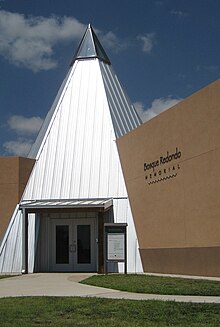
Similar some internment camps involving several tribes, the Bosque Redondo had serious problems. About 400 Mescalero Apaches were placed there before the Navajos. The Mescaleros and the Navajo had a long tradition of raiding each other; the 2 tribes had many disputes during their encampment. Furthermore, the initial program was for around 5,000 people, certainly not 10,000 men, women, and children. Water and firewood were major issues from the offset; the h2o was brackish and the round grove of copse was quite modest. Nature and humans both acquired crop failures every year. The corn crop was infested with regular army worms and failed repeatedly. The Pecos River flooded and done out the head gates of the irrigation system. In 1865 Navajo began leaving. By 1867 the remaining Navajo refused to plant a ingather.[19] Comanches raided them frequently, and they raided the Comanche, once stealing over 1,000 horses. The non-Indian settlers also suffered from the raiding parties who were trying to feed their starving people on the Bosque Redondo. And in that location was inept direction of what supplies were purchased for the reservation. The ground forces spent every bit much every bit $1.5 million a year to feed the Indians. In 1868 the experiment—meant to be the offset Indian reservation west of Indian Territory—was abandoned.[ citation needed ] A memorial site honoring those who were incarcerated at Bosque Redondo is located at Fort Sumner, New Mexico.[20]
Treaty of Bosque Redondo [edit]
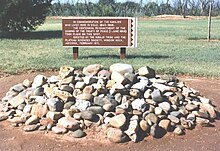
Marker where the Treaty of June i, 1868 was signed
The Treaty of Bosque Redondo betwixt the United states and many of the Navajo leaders was ended at Fort Sumner on June 1, 1868. Some of the provisions included establishing a reservation, restrictions on raiding, a resident Indian Agent and agency, compulsory education for children, the supply of seeds, agricultural implements and other provisions, rights of the Navajos to exist protected, establishment of railroads and forts, compensation to tribal members, and arrangements for the return of Navajos to the reservation established by the treaty. The Navajo agreed for ten years to transport their children to schoolhouse and the U.Southward. authorities agreed to establish schools with teachers for every thirty Navajo children. The U.S. authorities also promised for ten years to give to the Navajos annually: clothing, goods, and other raw materials, not exceeding the value of five dollars per person, that the Navajos could non industry for themselves.[21]
The signers of the document were: W. T. Sherman (Lt. General), S. F. Tappan (Indian Peace Commissioner), Navajos Barboncito (Master), Armijo, Delgado, Manuelito, Largo, Herrero, Chiquito, Muerte de Hombre, Hombro, Narbono, Narbono Segundo and Ganado Mucho.[21] Those who attested the document included Theo H. Dodd (Indian Agent) and B. S. Roberts (General 3rd Cav).
Return and end of Long Walk [edit]
On June xviii, 1868, the once-scattered bands of people who phone call themselves Diné, set off together on the return journeying, the "Long Walk" home. This is i of the few instances where the U.South. authorities permitted a tribe to return to their traditional boundaries. The Navajo were granted 3.5 million acres (14,000 kmtwo) of state inside their four sacred mountains. The Navajo also became a more cohesive tribe subsequently the Long Walk and were able to successfully increase the size of their reservation since then, to over sixteen meg acres (70,000 km2).
Subsequently relating 20 pages of material apropos the Long Walk, Howard Gorman, age 73 at the fourth dimension, concluded:
As I have said, our ancestors were taken captive and driven to Hwéeldi for no reason at all. They were harmless people, and, even to appointment, nosotros are the same, property no harm for anybody...Many Navajos who know our history and the story of Hwéeldi say the same.
— Navajo Stories of the Long Walk Period [22]
Legacy [edit]

Long Walk Home, mural past Richard Thou. Yazzie, 2005
Wellness impacts [edit]
Some[ who? ] speculated that the battles between U.Southward. troops and the Navajo and factors such as disease and famine reduced the Navajo population of approximately 25,000 to somewhere in the neighborhood of 2,000 Navajo of reproductive historic period, creating a genetic bottleneck. This produced the consequence of sure otherwise rare genetic diseases, for example Xeroderma pigmentosum, stemming from recessive genes to present with greater say-so.[23] An alternative put forth by some Navajo is that the sudden ascent of xeroderma pigmentosum is directly related to wide spread uranium contamination.[24]
In fine art [edit]
Navajo artist Richard Yard. Yazzie created a mural entitled Long Walk Habitation for the city of Gallup, New Mexico. Information technology is located at the intersection of Third and Loma streets. It is rendered in the 4 "sacred colors", black, white, blue and yellow.[25]
In literature [edit]
A supposed remnant of the Long Walk from Bosque Redondo, a rug called Woven Sorrow, figures prominently equally a valuable antique in the plot of The Shape Shifter by Tony Hillerman, published in 2006. Anne Hillerman mentioned the Long Walk in a subsequent novel in the series, Cavern of Bones (2018).
The story of the forced relocation is the setting of the youth fiction novel The Girl Who Chased Abroad Sorrow, written in 1999 by Ann Turner.
Another novel depicting the Long Walk from Bosque Redondo is the Welsh novel I Ble'r aeth Booty y Bore? by Eurig Wyn. This Welsh language novel follows a number of characters (some historic, others created by the author), and focuses not only on the Navajos, but likewise the Apache.
In the 1979 Stephen King novel The Long Walk (written under the pen name Richard Bachman) two Hopis are among one hundred teenage boys who participate in a competitive and voluntary death march which serves every bit a macabre annual spectacle in a totalitarian re-imagining of America.
Scott O'Dell's Newbury Laurels-winning book Sing Downwardly the Moon (1970) depicts the forced migration of the Navajos to Bosque Redondo.
Gallery [edit]
-

Long Walk of the Navajo, 1864
-
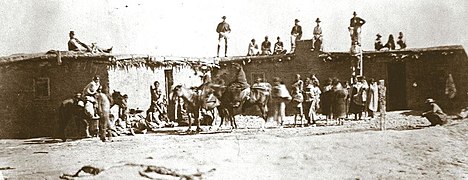
Navajo captives at Fort Sumner, c. 1860s
-

Wife of Navajo Chief Manuelito, the concluding Navajo master, c. 1900
-

Girl of Navajo Principal Manuelito, c. 1901
-
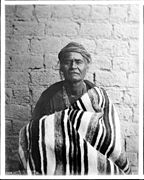
Portrait of son-in-law of Master Manuelito, c. 1901
-
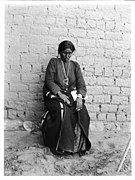
Bullheaded daughter of Principal Manuelito, c. 1901
-
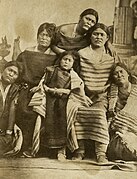
Navajo women, Long Walk of the Navajo
-
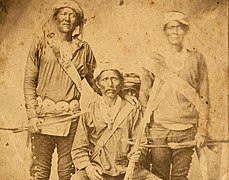
Navajo leaders – Long walk of the Navajo
See besides [edit]
- California Genocide
- Trail of Tears
- Indian removal
- 1837 Keen Plains smallpox epidemic
- Comanche campaign
- Yavapai Wars
- Northern Cheyenne Exodus
Notes [edit]
- ^ Often truces, ceasefires and armistices are mistakenly called treaties. Treaties in the United states accept been ratified by the U.s.a. Senate. A truce or armistice are agreements between combatants simply not ratified by the Usa Congress. For example, The Bonnville Treaty of 1858 was agreed to past Navajo and the Usa Military merely information technology was never ratified by the US Senate.
References [edit]
- ^ Anderson, Gary C. Ethnic Cleansing and the Indian: The Crime that Should Haunt America. University of Oklahoma Press. Oklahoma Metropolis, 2014.
- ^ Lee, Lloyd ed. Navajo Sovereignty. Understandings and visions of the Diné People. University of Arizona Press: Tucson, 2017.
- ^ Csordas, Thomas J. (Feb 1999). "Ritual Healing and the Politics of Identity in Contemporary Navajo Lodge". American Ethnologist. Blackwell Publishing on behalf of the American Anthropological Association. 26 (1): 3–23. doi:10.1525/ae.1999.26.ane.iii. JSTOR 647496.
- ^ Burnett, John (June 14, 2005). "The Navajo Nation'due south Own 'Trail Of Tears'". NPR All Things Considered . Retrieved July xxx, 2012.
- ^ Forbes, Jack D. (1960). Apache, Navajo and Spaniard. Norman, OK: Academy of Oklahoma Press. LCCN sixty-13480. OCLC 244951.
- ^ Calhoon to Medill, October 1, 1849, from National Archives for Navajo State Claims Case, at Navajo Tribal Museum, Window Rock AZ
- ^ Thompson, Gerald (1976). The Army and the Navajo: The Bosque Redondo Reservation Experiment 1863–1868 . Tucson, Arizona: The University of Arizona Press. ISBN0-8165-0495-4.
- ^ "Documents relating to the negotiation of an unratified treaty of Feb 15, 1861, with the Navajo Indians". February 15, 1861.
- ^ Thompson, Jerry D. (2015). A Civil War History of the New Mexico Volunteers and Militia. Albuquerque, New United mexican states: University of New Mexico Press. ISBN978-0-8263-5568-three.
- ^ McNitt, Frank (1990). Navajo Wars: Military Campaigns, Slave Raids, and Reprisals. University of New Mexico Printing. pp. 428–429. ISBN9780826312266.
- ^ a b *Cheek, Lawrence W. (2004). The Navajo Long Walk. Tucson: Rio Nuevo Pub.
- ^ a b Iverson, Peter (2000). Diné: A History of the Navajos. Albuquerque: Univ. New United mexican states Printing.
- ^ Roessel, Ruth, ed. (1973). Navajo Stories of the Long Walk Menses. Tsaile, Arizona: Navajo Customs College Press. ISBN978-0-912586-16-8.
- ^ Source: Fred "Dutch" Knoblock who was married to Alice Field.
- ^ Reséndez, Andrés. The Other Slavery: The Uncovered Story of Indian Enslavement in America (p. 286). Houghton Mifflin Harcourt. Kindle Edition.
- ^ Reséndez, Andrés. The Other Slavery: The Uncovered Story of Indian Enslavement in America (p. 287). Houghton Mifflin Harcourt. Kindle Edition.
- ^ "Navajos [] were captured en route and sold off throughout New United mexican states, Colorado, and northern Mexico." Reséndez, Andrés. The Other Slavery: The Uncovered Story of Indian Enslavement in America (p. 293). Houghton Mifflin Harcourt. Kindle Edition.
- ^ Page 168, Kelly, Navajo Roundup
- ^ "The Bosque Redondo Memorial". Bosque Redondo Memorial at Fort Sumner Land Monument. Retrieved March iv, 2021.
- ^ Gorman, Howard (1973). "1864: The Navajo begin 'Long Walk' to imprisonment". Native Voices. U.S. National Library of Medicine. Retrieved January 28, 2013.
- ^ "A Rare Genetic Disorder Is Stalking the Children of the Navajo Nation In POV'due south 'Sun Kissed,' Premiering Thursday, Oct. eighteen, 2012, on PBS". POV Documentaries with a Point of View. PBS. Retrieved Nov half dozen, 2014.
- ^ http://www.peoplesworld.org/article/rare-disease-suddenly-arises-on-navajo-reservation/ review of Sun Kissed
- ^ "Gallup Murals". Gallup Chamber of Commerce. Retrieved March 4, 2021.
Bibliography [edit]
- Bailey, Lynn R. (1970). Bosque Redondo: An American Concentration Camp . Pasadena, California: Socio-Technical Books.
- Bial, Raymond (2003). Neat Journeys: The Long Walk – The Story of Navajo Captivity. New York: Benchmark Books. ISBN978-0-7614-1322-6.
- Brown, Dee (1970). Bury My Heart at Wounded Knee. ISBN978-0-330-23219-7.
- Kelly, Lawrence (1970). Navajo Roundup: Selected Correspondence of Kit Carson's expedition Against the Navajo, 1863–1865 . Colorado: Pruett Publishing Visitor. ISBN978-0-87108-042-4.
- McNitt, Frank (1972). Navajo Wars . Colorado: Univ. New Mexico Printing. ISBN978-0-8263-0051-five.
- Roberts, Susan A. & Calvin A. Roberts (1988). New Mexico. Albuquerque: Univ. New Mexico Printing. ISBN978-0-8263-1145-0.
- Simmons, Marc (1973). The Little Lion of the Southwest: a life of Manuel Antonio Chaves. Chicago: The Swallow Press. ISBN978-0-8040-0633-0.
- Thompson, Gerald (1976). The Regular army and the Navajo: The Bosque Redondo Reservation Experiment 1863–1868 . Tucson, Arizona: The Academy of Arizona Press. ISBN978-0-8165-0495-iv.
- Roessel, Ruth, ed. (1973). Navajo Stories of the Long Walk Period. Tsaile, Arizona: Navajo Customs College Press. ISBN978-0-912586-16-eight.
- Iverson, Peter (2002). Diné: A History of the Navajos. Albuquerque: Univ. New Mexico Printing.
- Cheek, Lawrence W. (2004). The Navajo Long Walk. Tucson: Rio Nuevo Pub.
- The Diné of the Eastern Region of the Navajo Reservation (1990). Oral Stories of the Long Walk. Crownpoint: Lake Valley Navajo Schoolhouse.
External links [edit]
DOWNLOAD HERE
Posted by: richardandised1971.blogspot.com
Post a Comment